
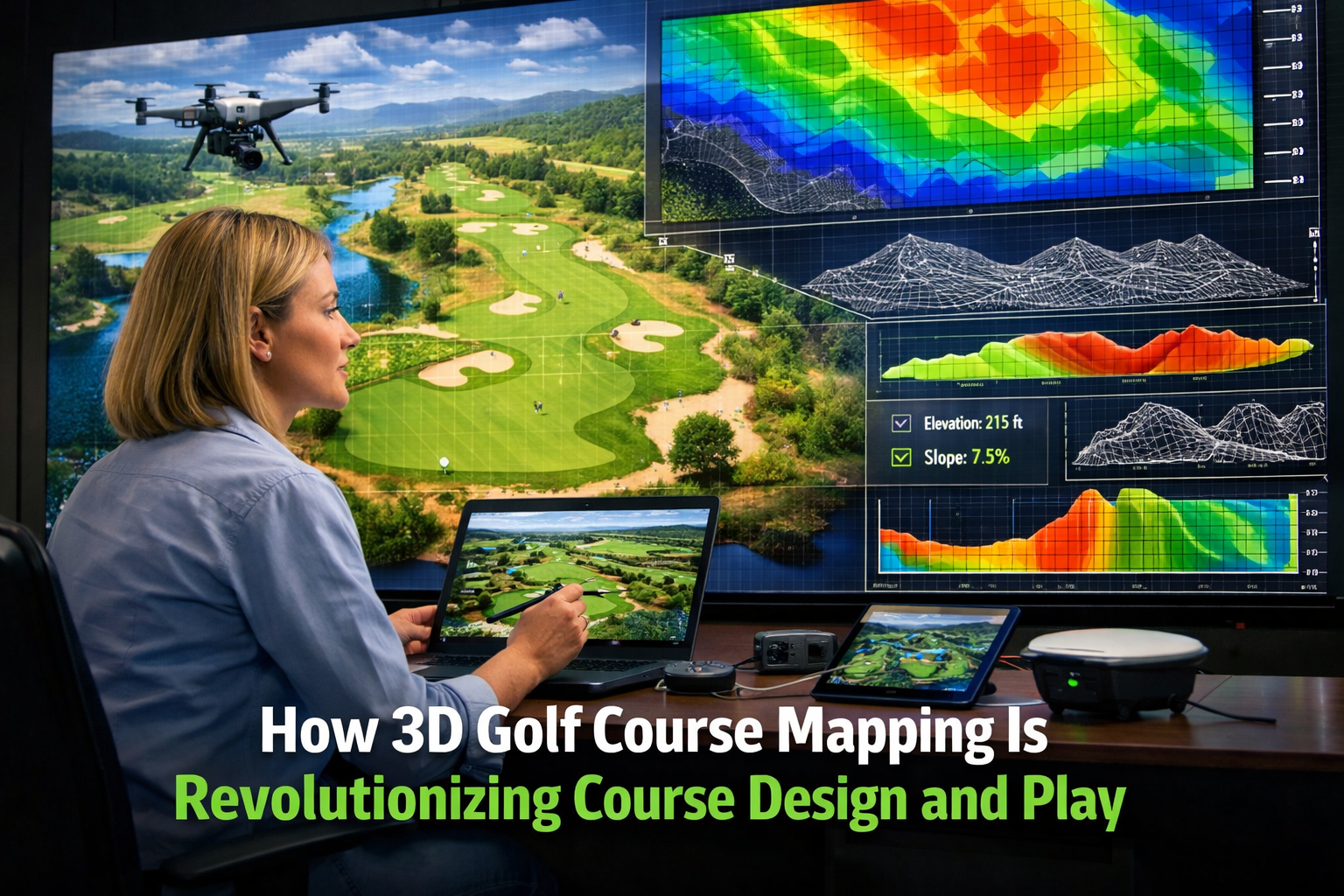
The process of mapping golf courses in three dimensions is changing the way designers, players, and superintendents perceive and engage with golf courses. 3D golf course mapping combines geospatial data, drone-based images, and advanced rendering capabilities to create a 3D model of the whole course. From slope gradients to bunkers, everything is captured in photorealistic detail, allowing for more intelligent course design and maintenance plans, and improved on-screen and on-course player enjoyment.
1. Enhancing Player Experience through 3D Golf Visualization
Digital 3D representation of the course allows a personalized experience of mapping out fairways, greens, and hazards from a virtual mode prior to your actual visit. It prepares the player for the golf course and increases engagement and an analytical experience.
- Includes a virtual flyover and panoramic views of each hole.
- Allows for elevation, wind, and slope analysis.
- When simulators are used, it provide realistic practice experiences.
2. Creating Realistic Environments with Photorealistic Golf Maps
Photorealistic golf maps combine satellite imagery with golf course 3D rendering methods to recreate the full contour and texture of a real golf course. These graphics are so realistic that they’ve been used for advertisements, instructional materials, and even AR/VR golf simulations.
- Perfect for marketing and digital graphics for golf clubs.
- Accurately portrays relief, vegetation, and light conditions.
- Used for interactive displays in golf showrooms and tournaments.
3. Engaging Audiences with Immersive Golf Course Animation
Golf course animation breathes life into digital models by showcasing ball trajectories, environmental effects, and player movements. These dynamic visuals are widely used for training simulations, tournament previews, and television broadcasts to make the game more captivating.
- Demonstrates ball flight paths and realistic physics.
- Adds storytelling elements to course presentations.
- Elevates brand engagement through interactive visuals.
4. Precision and Aesthetics through Golf Course 3D Rendering
Golf course 3D rendering combines artistry with technical precision, helping designers visualize their concepts before construction. It provides detailed renderings of greens, bunkers, and fairways, ensuring that every contour and shade contributes to a visually stunning and functional course.
- Visualizes complex terrain models with realistic lighting.
- Enables quick design modifications during planning.
- Supports virtual walkthroughs and pre-construction presentations.

A novel phase in Golf Course Planning and Design
Use of 3D mapping allows architects and planners to see course layouts with unprecedented clarity. Analyzing topography, water flow and soil data allows designers to maximize performance, safety and sustainability in the course design, reducing costly mistakes long before physical construction takes place and before weather conditions become involved.
Integrating with Golf Simulators and AR Experiences
By using AR and simulation technologies, golfers can play their favorite courses through simulation. 3D golf maps utilize simulators to allow golfers to play through famous courses in digital form while providing the golfer with a realistic gaming experience similar to what they would face in the real world.
Increasing efficiency in maintenance and management
Course managers are utilizing the 3D maps to track landscape alterations, irrigation systems, and wear patterns; thus improving efforts for procrastination. More effective management means healthier, consistent playability throughout the year while minimizing resource effort.
Marketing and Digital Storytelling opportunities for Golf Clubs
3D golf renderings and animations, on behalf of golf clubs, can also develop some marketing videos. Golf clubs can utilize 3D renderings for engaging website tours of their course, video tour footage of their signature holes to showcase their unique course beauty and tell the golf clubs story to potential members.
Frequently Asked Questions

Founder & CEO
Bigyan Kar is the driving force behind Geoshot Technologies and has been since its founding, leading the company’s vision in delivering advanced CAD, GIS, graphics, map illustrations, and 3D solutions across multiple industries. While Geoshot serves a wide range of sectors, Bigyan has maintained a strong specialization in golf course graphics, CAD drafting, and mapping—ensuring highly accurate and visually compelling representations for golf architects and planners.