
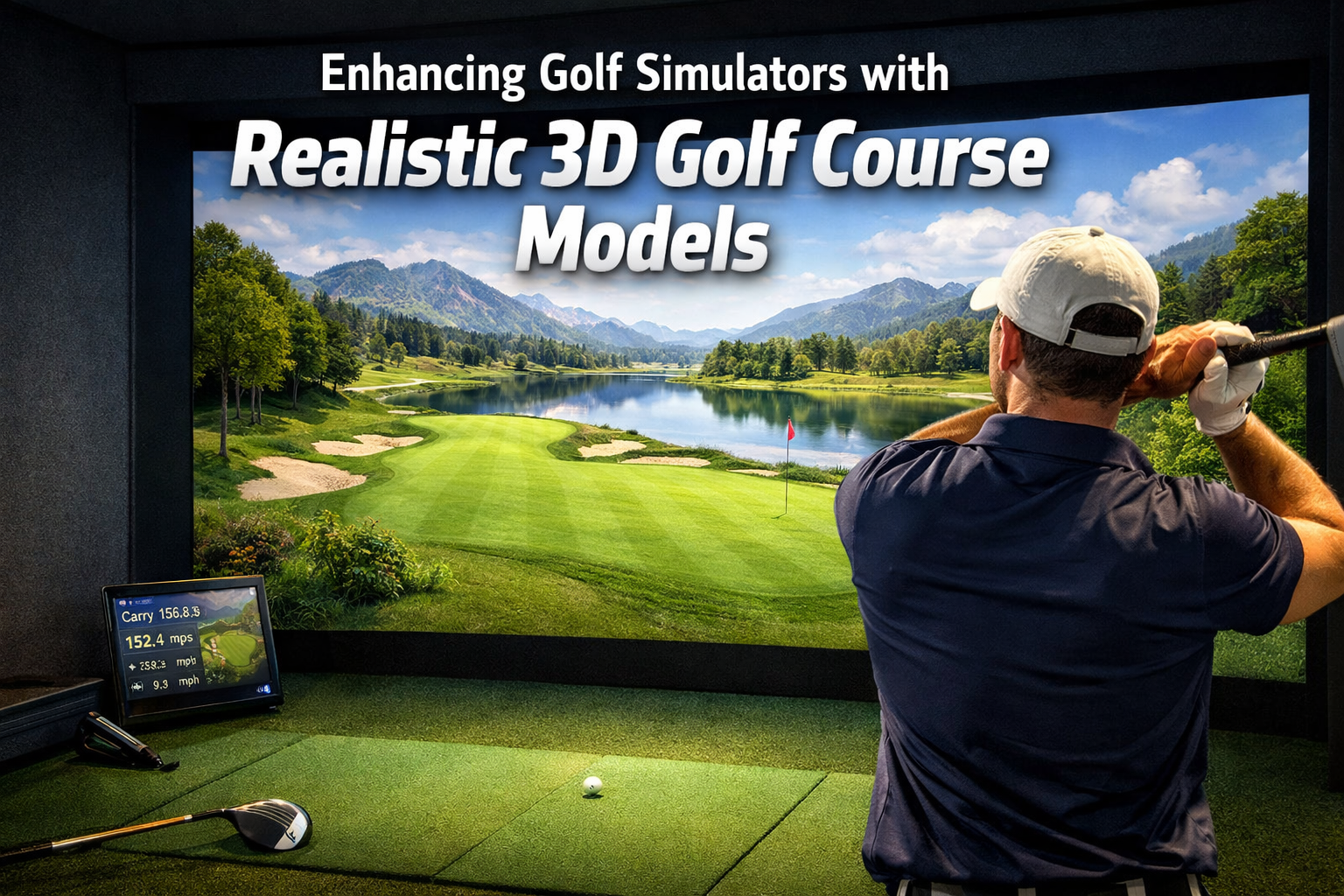
Modern golf simulators and virtual reality experiences are leveraging the advancements in realistic three-dimensional (3D) golf course models. Users can experience realistic gaming environments, terrain features, and immersive play in 3D golf simulators and virtual reality (VR) products. Advanced 3D modelling technologies enable the creation of hyper-accurate elevation models, photorealistic terrain textures, and detailed terrain representations that replicate actual golf courses in a digital format with an incredibly high level of accuracy. Realistic golf course models have enhanced visual accuracy and overall user experience for people training, having fun, or previewing (virtual) golf courses and allow people to play with the same realism as if they were on a real golf course.
Why Golf Simulators Need Advanced 3D Rendering and Realistic Graphics
Top-tier simulators are reliant on advanced 3D course rendering to replicate real course conditions. Through the use of realistic textures, lighting, foliage, and high-resolution terrain, golfers can have immersive and accurate experiences. The advancements make the players more engaged in gameplay, provide lifelike practice sessions, and create next-level AR/VR golf environments.
Key Features That Enhance Accuracy in 3D Golf Course Models
1. Ultra-Detailed Terrain Mapping
Using drone data, LiDAR scans, and high-precision elevation models, designers create ultra-realistic terrains. Every slope, contour, bunker depth, and fairway roll is replicated to match real-world conditions, ensuring the virtual game plays exactly like the actual golf course.
2. Photorealistic Textures and Lighting
Textures for greens, rough, sand, water, and trees are crafted with 4K detail. Realistic lighting simulations mimic time-of-day changes, shadows, sunlight angles, and weather conditions. This level of detail boosts immersion and makes virtual courses immediately recognizable.
3. Real-World Object Integration
Elements like clubhouses, bridges, pathways, and course landmarks are modeled in 3D to match real locations. This enhances visual authenticity and allows golfers to virtually explore the course before visiting in person.
4. Dynamic Weather and Physics Simulation
Accurate ball physics, wind modeling, rain effects, and surface friction help create a realistic playing environment. These systems ensure that each shot behaves as expected, offering true-to-life practice and gameplay.
Benefits of Realistic 3D Golf Course Models for Simulators & VR
In AR and VR, realistic 3D golf course models bring an unmatched immersive experience. Players can walk fairways, preview shots, and feel present on the course. This boosts engagement, makes virtual tournaments exciting, and turns digital golfing into a near-physical experience.
1. Enhanced Immersion for Players
High-quality graphics and lifelike spatial audio create an environment where players feel and react like they’re on an actual golf course. This results in deeper emotional engagement and more satisfying gameplay.
2. Improved Training and Skill Development
Coaches and players use accurate models to analyze swing impacts, shot placements, and course strategies. Virtual practice becomes more meaningful because the digital terrain behaves like the real course.
3. Better Course Visualization for Designers
Golf architects and course owners use VR visualizations to review new designs, modify layouts, and test features instantly. It reduces planning time and improves decision-making.
4. Increased Revenue Opportunities for Course Owners
Digital twin versions of golf courses can be licensed to simulator companies, used for marketing, or integrated into tournaments. This expands reach and builds global exposure.
Comparing Traditional Graphics vs. Modern 3D Golf Course Models
| Feature | Traditional Graphics | Modern Photorealistic 3D Models |
| Terrain Accuracy | Basic, low detail | LiDAR-based, highly precise |
| Lighting & Shadows | Static | Dynamic, real-time |
| Player Immersion | Limited | Deeply immersive |
| Real-World Replication | Approximate | Nearly identical |
| AR/VR Compatibility | Low | Fully compatible |
Essential Elements in Creating Realistic Golf Simulator Models
Creating highly accurate 3D golf simulations requires a combination of top-tier modeling skills, real-world data, and optimized rendering pipelines. Professional 3D modeling services ensure courses are designed with proper scale, textures, and interactive accuracy for VR and simulator environments.
1. Data Collection and Course Surveying
LiDAR, drones, GPS scans, and high-resolution photos capture every detail. This data ensures the 3D model matches real-world measurements and course features.
2. Terrain Sculpting and Surface Modeling
Artists sculpt terrain based on elevation data, shaping greens, fairways, bunkers, and water bodies with precision. This step lays the foundation for realistic gameplay physics.
3. Texture Application and Material Setup
Natural textures are applied to create realistic grass, sand, stone, and foliage. Material settings define how surfaces reflect light and interact with the weather.
4. Optimization for Game Engines
To ensure smooth performance on simulators and VR headsets, models are optimized with efficient poly counts, LOD systems, and engine-ready file formats like FBX or glTF.
Frequently Asked Questions

Founder & CEO
Bigyan Kar is the driving force behind Geoshot Technologies and has been since its founding, leading the company’s vision in delivering advanced CAD, GIS, graphics, map illustrations, and 3D solutions across multiple industries. While Geoshot serves a wide range of sectors, Bigyan has maintained a strong specialization in golf course graphics, CAD drafting, and mapping—ensuring highly accurate and visually compelling representations for golf architects and planners.